When businesses look to cut costs and scale operations, two models come up most often. The first is BPO. The second is staff augmentation. However, most people use these terms interchangeably, and that is a mistake that leads to choosing the wrong model. Understanding the real difference between BPO vs staff augmentation could save your business time, money, and a lot of operational frustration. In this guide, we break down exactly what each model is, when to use each one, and how to decide which fits your business right now.
What Is BPO?
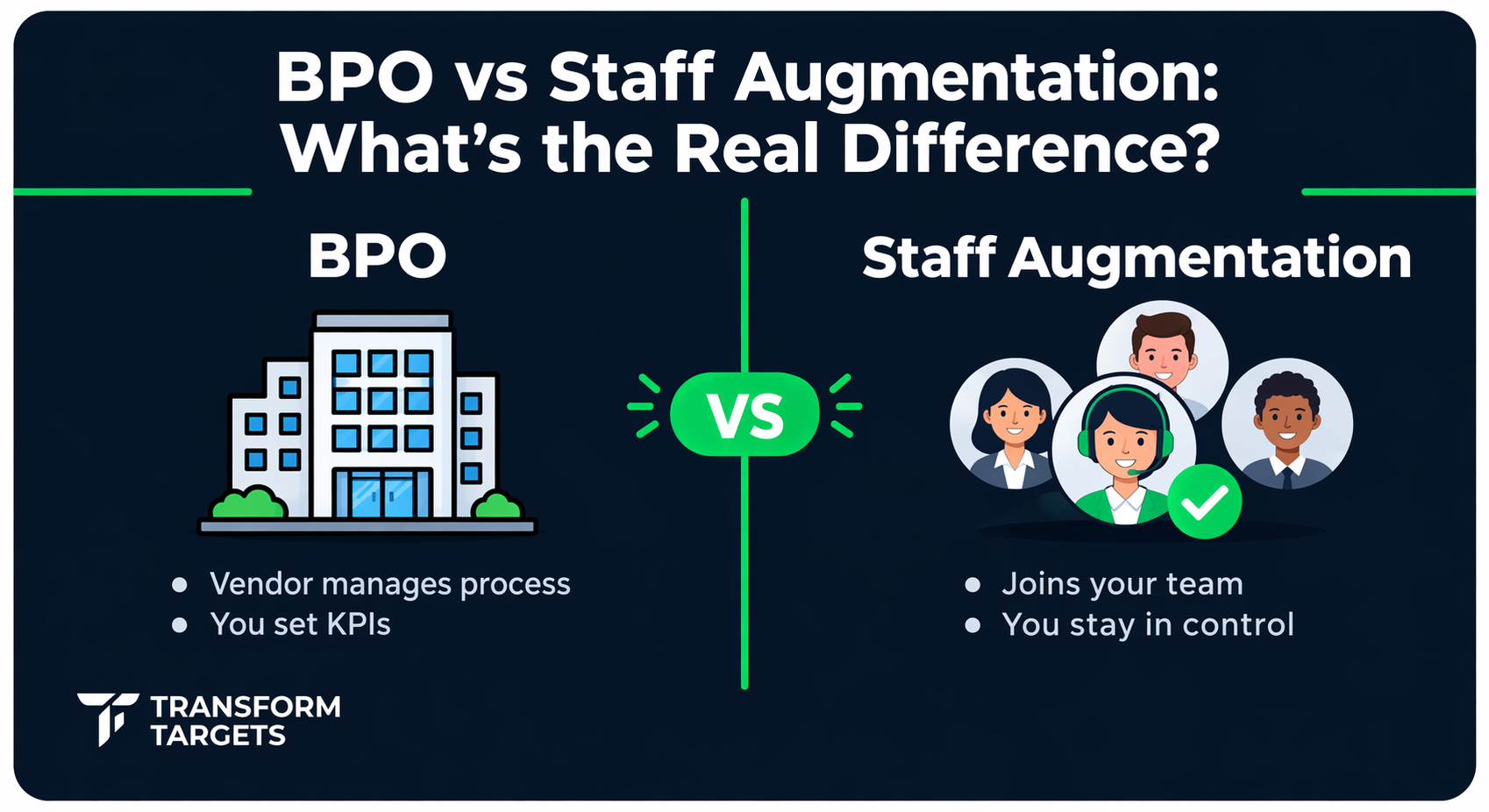
BPO stands for Business Process Outsourcing. In a BPO arrangement, you hand over an entire business process to an external vendor. That vendor owns the process, manages the team, and delivers results against agreed performance targets. You set the KPIs. They handle everything else, including hiring, training, supervision, and quality control.
For example, a company might outsource its entire customer service operation to a BPO firm. The BPO firm hires and manages the agents, runs the quality assurance checks, and reports results back to the client. Furthermore, the client does not manage individual agents. They manage the vendor relationship and the outcomes.
BPO works well for high-volume, well-defined processes that do not change often. Common examples include large-scale customer service, accounts payable processing, payroll administration, and data entry at scale. In fact, the global BPO market is worth hundreds of billions of dollars because many businesses benefit from fully handing off these repeatable processes to specialists.
What Is Staff Augmentation?
Staff augmentation is a different model. Instead of handing a process to a vendor, you hire offshore workers who join your existing team directly. These individuals work inside your tools, follow your processes, and report to your managers, just like any in-house employee. The key difference is that they are sourced, vetted, and placed by an offshore staffing partner, which removes the overhead of recruiting and employing them locally.
In a staff augmentation arrangement, you stay in full control. You decide how the work gets done, what tools are used, what standards must be met, and how the team is managed day to day. Your offshore hire represents your brand directly. Consequently, there is no middle layer of vendor management standing between you and the quality of the output.
This model is particularly popular for customer experience teams, digital marketing, virtual assistance, back-office roles, and technical support. It is also the preferred model for companies that want their offshore team to carry the same culture and voice as their in-house operation.
BPO vs Staff Augmentation: The Core Differences
Understanding BPO vs staff augmentation comes down to five key dimensions. Here is how the two models compare directly.
1. Control
In a BPO model, the vendor controls the process. You measure outcomes and manage the vendor relationship. In staff augmentation, you control everything. Your managers direct the work, set the priorities, and shape the team culture. Therefore, if control and brand consistency matter to you, staff augmentation is the stronger choice.
2. Integration
BPO teams typically work within the vendor’s own systems and processes. Staff augmentation hires work inside your systems, your CRM, your support platform, and your internal tools. As a result, the staff augmentation model produces tighter integration with your existing operations and a more consistent experience for your customers.
3. Scalability
Both models allow you to scale without the cost and time of local hiring. However, BPO is often better suited to rapid, large-scale ramp-ups because the vendor manages the headcount surge internally. Staff augmentation scales more precisely because you select and approve every person who joins your team. Consequently, staff augmentation produces better quality at scale, while BPO produces faster volume at scale.
4. Cost
Both models cut costs significantly compared to local hiring. In fact, offshore staffing of either kind typically saves 40 to 60 percent per person compared to equivalent US-based roles. Furthermore, staff augmentation models usually have lower management overhead because you are not paying for a vendor’s internal QA and supervision layer. On the other hand, BPO includes full process management in the price, which can justify the higher per-seat cost for complex, high-volume operations.
5. Brand Voice and Quality
This is where the difference matters most for customer-facing teams. In a BPO model, agents represent multiple clients. They may follow your script, but they work for the vendor first. In staff augmentation, your offshore hire works exclusively for your brand. Therefore, they develop deep product knowledge, learn your specific tone, and produce customer interactions that feel like a true extension of your in-house team.
When to Choose BPO Over Staff Augmentation
The BPO model fits best when you have a large-volume, well-defined process that you are comfortable handing over entirely. Choose a BPO partner when:
- You need to process hundreds of thousands of transactions with no variation, such as bulk data entry, document processing, or large-scale billing.
- You do not want to manage the team directly and prefer to measure outcomes instead.
- Speed of deployment is the top priority and you cannot spend time vetting individual hires.
- The process is standardized enough that vendor management does not create risk to quality or brand consistency.
When to Choose Staff Augmentation Over BPO
The staff augmentation model fits best when integration, brand voice, and control matter to you. Choose staff augmentation when:
- Your offshore team will interact directly with customers in your brand’s name.
- You want to build long-term institutional knowledge within a dedicated team.
- You need people embedded in your existing tools and workflows rather than working in a separate vendor environment.
- You are scaling a customer experience, virtual assistant, back-office, or marketing operation and want the offshore team to feel like a true part of the company.
- Quality and consistency matter more than the fastest possible deployment speed.
Furthermore, staff augmentation is often the better long-term investment. BPO relationships can become transactional over time, with agents cycling in and out. In contrast, a dedicated staff augmentation hire builds knowledge and loyalty. As a result, your customers receive better service and your operations become more efficient over months and years.
Common Mistakes When Choosing Between BPO vs Staff Augmentation
Many businesses choose the wrong model because they focus on cost alone. However, the cheapest option is rarely the right option. Here are the mistakes to avoid:
- Assuming BPO always costs less. BPO can appear cheaper upfront, but hidden management fees, transition costs, and quality remediation often close the gap. Staff augmentation with a good partner is frequently more cost-effective at scale.
- Choosing staff augmentation without a clear management plan. Staff augmentation requires your managers to lead the offshore team. If you do not have the internal bandwidth to manage additional headcount, BPO may be a better fit until you do.
- Ignoring the integration requirements. BPO teams often need weeks to get set up in your systems and processes. Staff augmentation hires integrate faster when the staffing partner has real experience with your tools. Therefore, always ask about tool integration timelines before you decide.
Why Transform Targets Offers the Best of Both BPO and Staff Augmentation
Transform Targets is a US-based offshore staffing and BPO company that offers both models. However, it is built around the staff augmentation approach at its core, because that is the model that produces the most consistent quality, the strongest brand integration, and the best long-term results for growing businesses.
Here is why Transform Targets stands out in the BPO vs staff augmentation conversation:
- 50 to 60 percent cost savings per person, with no startup costs and no hidden fees. Savings begin on day one.
- You select every hire. Review and approve each candidate before they join your team. Consequently, you get the right skills, experience, and culture fit every time.
- Deep team integration. Your offshore staff work inside your tools, follow your workflows, and represent your brand directly. They are not shared across other clients.
- Full-service capability. From customer experience and staff augmentation to back-office operations and digital transformation, Transform Targets covers the full range of offshore staffing and BPO needs under one partner.
- Texas-based management. US-aligned oversight, communication, and standards across every engagement.
- Fast ramp-up. Most clients have a trained team live within two to four weeks.
Additionally, Transform Targets helps you decide which model fits your business before you commit. If you are unsure whether BPO or staff augmentation is the right approach for your specific operation, their team will walk you through both options with no pressure.
Ready to Choose the Right Model for Your Business?
The BPO vs staff augmentation decision shapes how your offshore operation runs, how your customers experience your brand, and how well your team scales over time. Choosing the wrong model now creates problems that cost far more to fix later.
Transform Targets has helped businesses across ecommerce, fintech, healthcare, and retail choose and build the right offshore model for their exact needs. Furthermore, clients consistently report that the staff augmentation approach produces teams that feel like a genuine part of the company, with lower turnover, deeper product knowledge, and higher CSAT scores than traditional BPO arrangements.
Book a free 30-minute call today. We will review your current operations, explain which model fits your goals, and show you exactly how much you could save. No obligation.
Book Your Free 30-Min Strategy Call with Transform Targets →