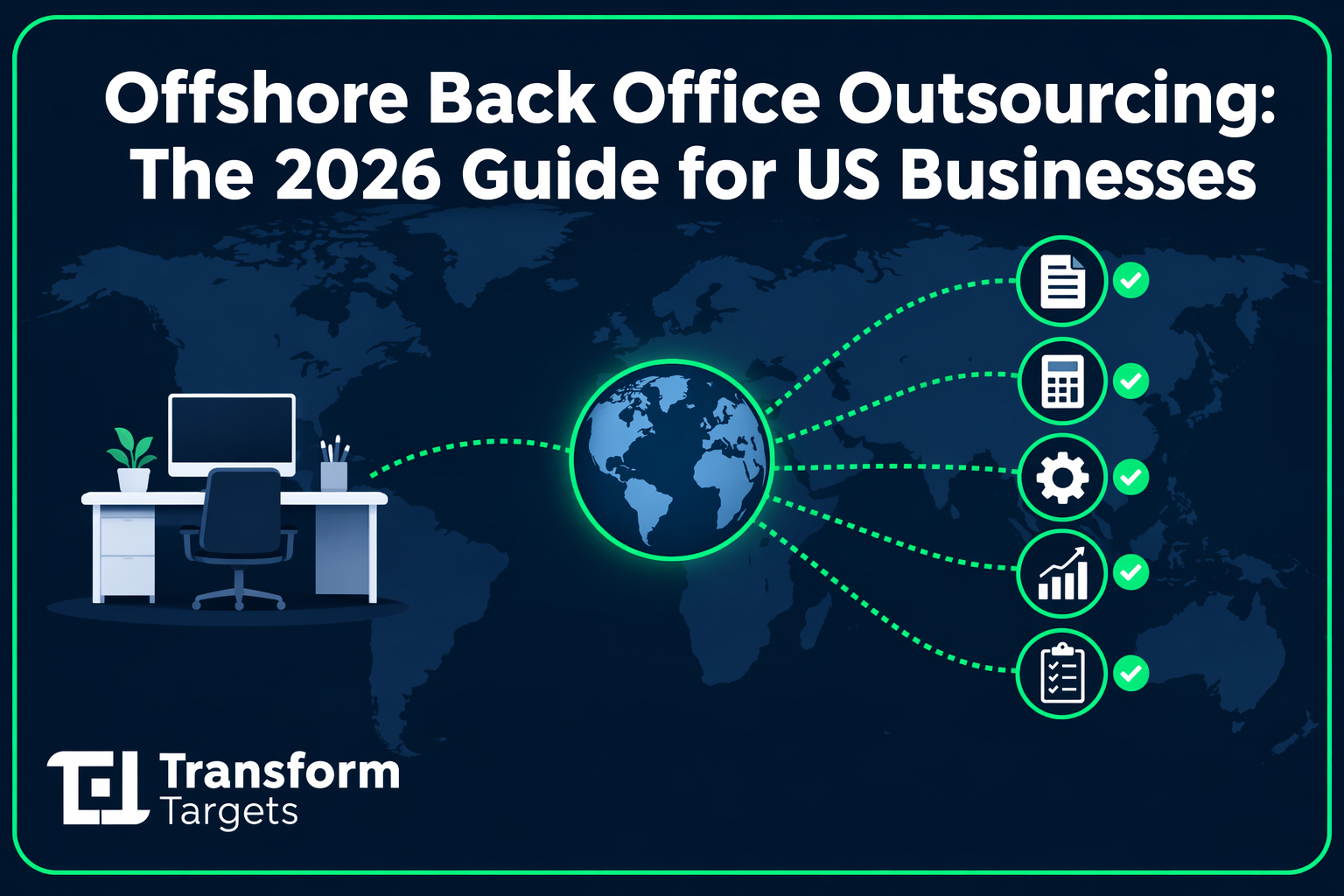
Every growing US business reaches the same point: the back office starts to slow the front office down. Admin backlogs build up, data entry falls behind, reporting takes too long, and the team that should be focused on revenue is stuck on operations. Offshore back office outsourcing is how smart US businesses solve this problem without hiring a full local team. In this guide, we cover exactly what qualifies as back office work, which processes are best suited for offshore delivery, how to choose the right partner, and what the real cost savings look like.
What Is Offshore Back Office Outsourcing?
Back office outsourcing means moving internal business operations — work that keeps the company running but is not customer-facing — to an external team. When that team is located offshore, typically in the Philippines, Latin America, South Asia, or Eastern Europe, it is called offshore back office outsourcing.
The back office covers a wide range of functions. Common examples include data entry and data management, accounts payable and receivable processing, payroll administration, order processing, compliance documentation, reporting and analytics, HR administration, and virtual executive assistance. In fact, any process that is repeatable, document-based, or system-driven is typically a strong candidate for offshore delivery.
Furthermore, offshore back office outsourcing is not the same as handing your operations to a black-box vendor. The best models are staff augmentation arrangements, where dedicated offshore employees work inside your own systems, follow your processes, and report to your managers. Consequently, you get the cost savings of offshore staffing without giving up control over how the work gets done.
Why US Businesses Are Moving Back Office Operations Offshore
The primary driver is cost. In fact, offshore back office outsourcing typically reduces per-seat costs by 50 to 60 percent compared to hiring locally in the US. For a team of five back office staff, that saving runs to hundreds of thousands of dollars per year, before accounting for office space, benefits, and employer taxes.
However, cost is not the only reason. US businesses also move back office operations offshore to solve a talent availability problem. Skilled administrators, data processors, and operations specialists are increasingly difficult to hire locally at the pay rates most small and mid-size businesses can sustain. Moreover, the roles are often repetitive, which leads to high local turnover and constant retraining costs. Offshore teams in established staffing markets are more stable and more willing to build long-term careers in these roles.
Additionally, offshore back office outsourcing gives businesses the ability to extend operating hours. A Philippines-based team can handle work overnight US time, so reports are ready when the US team starts their day and order backlogs are cleared before the morning shift begins. As a result, productivity increases without adding to the US headcount or the US payroll.
Which Back Office Processes Are Best Suited for Offshore Outsourcing?
Not every back office function transfers offshore equally well. Here are the processes that consistently deliver the strongest results from offshore back office outsourcing arrangements.
1. Data Entry and Data Management
High-volume, accuracy-dependent data work is the most natural fit for offshore delivery. This includes product catalog management, CRM data hygiene, database updates, and document digitisation. Therefore, if your team is spending hours per week on repetitive data tasks, this is the first process to move offshore.
2. Order Processing and Fulfilment Support
For ecommerce and retail businesses, order management — confirming orders, coordinating with fulfilment, handling exceptions and amendments — is a high-volume back office function that offshore teams handle exceptionally well. Furthermore, offshore order processing teams can operate around the clock, ensuring no order sits unprocessed overnight.
3. Accounts Payable and Receivable Support
Invoice processing, payment reconciliation, vendor communication, and accounts receivable follow-ups are all strong candidates for offshore back office outsourcing. However, this requires a provider with proven financial operations experience and strict data security standards. Always verify compliance certifications before moving financial data offshore.
4. Reporting and Business Analytics Support
Pulling weekly and monthly reports, building dashboards, cleaning and structuring data for analysis — this is work that takes skilled time but does not require physical presence in the US office. Consequently, many US businesses use offshore back office teams as an analytics support layer, freeing senior staff to interpret the data rather than prepare it.
5. HR and Payroll Administration
Scheduling, onboarding documentation, benefits administration, timesheet processing, and HR record management can all run effectively offshore, within a properly governed compliance framework. Additionally, offshore HR admin teams free in-house HR leaders to focus on strategy, culture, and high-value talent decisions rather than paperwork.
6. Virtual Executive Assistance
Calendar management, travel booking, inbox management, document preparation, research, and administrative coordination are all well-established offshore functions. In fact, executive assistance is one of the most consistently high-satisfaction categories in offshore back office outsourcing, because the role benefits from a dedicated individual rather than a shared service pool.
How to Evaluate an Offshore Back Office Outsourcing Partner
Choosing the wrong partner for offshore back office outsourcing creates more problems than it solves. Here are the five criteria that matter most.
- Dedicated versus shared teams. Shared back office pools divide agent attention across multiple clients. Dedicated teams work exclusively for your business, learn your systems, and build institutional knowledge over time. Therefore, always insist on a dedicated model for any process that requires continuity and accuracy.
- Tool and system integration. Your offshore team must work inside your existing platforms — your ERP, your CRM, your order management system, your reporting tools. A provider that asks you to switch to their own tools is adding friction and risk, not removing it.
- Data security and compliance. Any back office function that touches financial data, personal information, or compliance documentation requires a provider with documented security standards. Ask for their data handling policy, their access control framework, and any relevant certifications before you engage.
- Transparent, all-in pricing. Some offshore providers advertise low base rates and add management fees, training fees, and quality assurance charges on top. Consequently, always ask for the fully loaded per-seat cost before you compare providers.
- Hiring control and approval rights. The best offshore back office outsourcing providers let you review and approve every person who joins your team. This is the difference between building a team with the right skills and culture fit and inheriting whoever the vendor assigns.
Common Mistakes When Starting Offshore Back Office Outsourcing
Even well-run businesses make these errors when they first move operations offshore. However, knowing them in advance prevents the most expensive ones.
- Moving too many processes at once. Start with one well-defined process, get it running smoothly, and expand from there. Moving five back office functions offshore at the same time stretches your management bandwidth and makes it harder to diagnose problems when they arise.
- Skipping the process documentation step. Your offshore team cannot follow a process that has never been written down. Therefore, before you hand off any function, document the current workflow in step-by-step detail. This also forces you to identify inefficiencies before they get replicated offshore.
- Choosing a generic BPO instead of a dedicated model. Generic BPO providers cycle agents in and out of your account. As a result, knowledge is never retained, quality is inconsistent, and you are always retraining. A dedicated offshore staffing model eliminates this problem entirely.
- Ignoring time zone alignment. Some offshore back office outsourcing functions benefit from real-time overlap with the US team. Others can run asynchronously. Plan your offshore team’s working hours deliberately based on which model each process actually needs.
Why Transform Targets Is the Right Partner for Offshore Back Office Outsourcing
Transform Targets is a US-based offshore staffing and BPO company that builds dedicated back office teams for growing American businesses. However, it operates very differently from a standard outsourcing vendor. Every team member is selected and approved by the client, works inside the client’s own systems, and reports to the client’s managers directly. There is no vendor middle layer between your team and your results.
Here is what makes Transform Targets the right choice for offshore back office outsourcing:
- 50 to 60 percent cost savings per person, with no startup costs, no hidden fees, and savings beginning on day one.
- You approve every hire. Review each candidate’s profile, skills, and experience before they join your team. Consequently, you always get the right fit — not whoever is available.
- Full process integration. Your offshore back office team works inside your tools, follows your documented workflows, and operates as a true extension of your internal team.
- Back office expertise across all key functions. Data entry and management, order processing, accounts payable and receivable support, HR administration, reporting, and executive assistance — all covered under one partner.
- Fast ramp-up. Most clients have a trained back office team live and operational within two to four weeks.
- Texas-based management. US-aligned oversight, communication standards, and account management across every engagement.
Additionally, Transform Targets serves businesses across ecommerce, fintech, healthcare, real estate, insurance, and technology. Furthermore, clients consistently report that their offshore back office teams become one of the most reliable and well-integrated parts of the operation — because the model is built for long-term commitment, not short-term volume.
Ready to Move Your Back Office Offshore?
The right offshore back office outsourcing partner does not just reduce costs. It frees your in-house team from the operational weight that slows growth, improves accuracy and throughput across your core processes, and gives you a scalable operations layer that grows with the business. However, the key is starting with the right process, with the right model, and with a partner that lets you stay in control.
Transform Targets has helped US businesses across multiple industries build offshore back office teams that run reliably from day one. Furthermore, the model requires no long-term contract commitment and no upfront investment — you see the savings immediately and you decide how fast to scale.
Book a free 30-minute call today. We will review your current back office setup, identify which processes are best suited for offshore delivery right now, and show you exactly how much you could save. No obligation.
Book Your Free 30-Min Strategy Call with Transform Targets →